£2.50
In stock
Adding to the basket reserves nothing yet. You send a request, we confirm, then we send payment details - no card details are taken on this site.
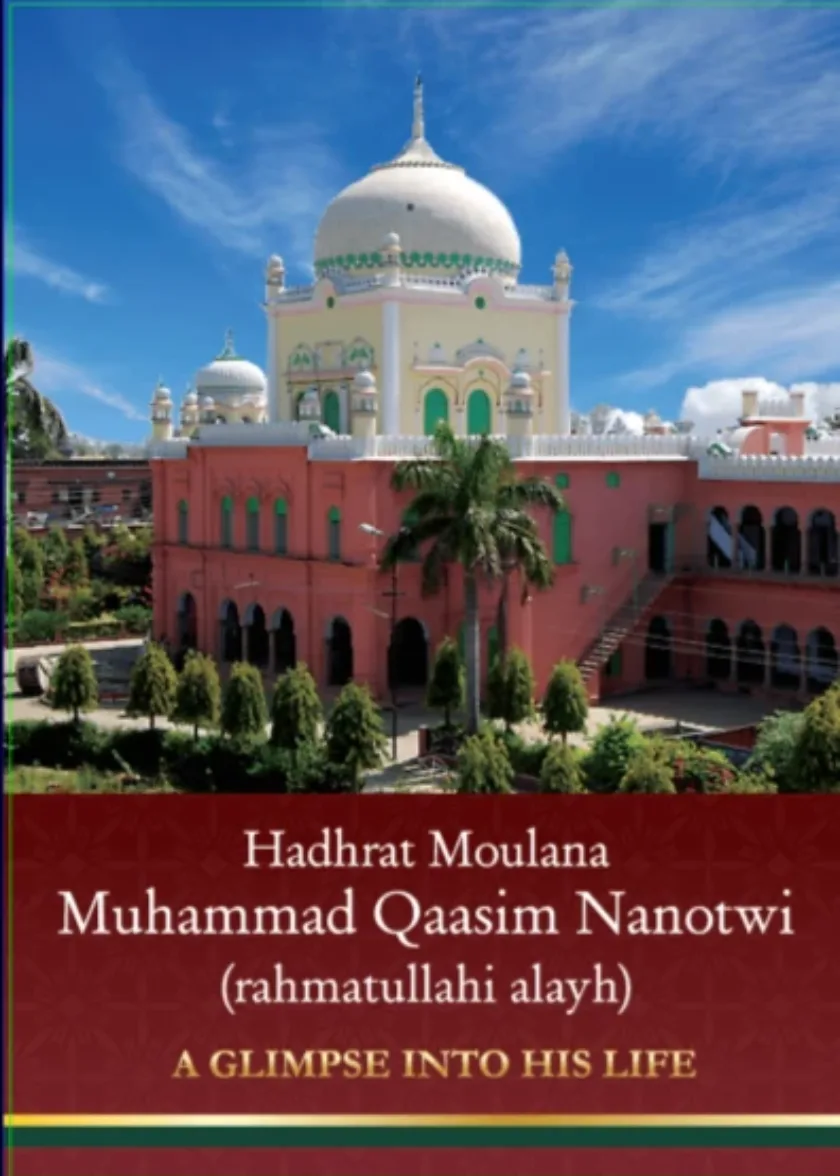
Ḥujjat al-Islām Mawlānā Muḥammad Qāsim Nānotwī رحمه الله
One of the Most Esteemed Personalities in Islamic History
Ḥaḍrat Mawlānā Muḥammad Qāsim Nānotwī رحمه الله stands among the most influential ʿUlamāʾ and reformers of nineteenth-century India. His immense contributions to Islamic scholarship, the revival of Islamic institutions, and the defence of Islām against colonial challenges laid foundations whose benefits continue to reach the Muslim Ummah across the world.
His name was Muḥammad Qāsim, while his historical name was Khurshīd Ḥusayn. He was the son of Asʿad ʿAlī and the grandson of Shaykh Ghulām Shāh. His lineage is traced to Qāsim ibn Muḥammad ibn Abī Bakr رضي الله عنهما, connecting him to a distinguished scholarly heritage. He was born in 1248 AH (1832 CE) in Nānotā, a town near Deoband, and passed away on Thursday, 4 Jumādā al-Ūlā 1297 AH (1879 CE), after Ṣalāh al-Ẓuhr.
Nānotā, his hometown, had long been a centre of Islamic influence. His ancestor, Mawlānā Muḥammad Hāshim رحمه الله, was closely associated with the Mughal Emperor Shāh Jahān and played a significant role in establishing Nānotā as a flourishing Islamic town. It was from this environment that Mawlānā Qāsim Nānotwī رحمه الله emerged as a guiding light for the Ummah.
Signs of exceptional brilliance were evident from his childhood. On one occasion, he saw a dream which his grandfather interpreted as an indication that Allāh Taʿālā would bless him with immense knowledge and widespread recognition. His intelligence, courage, diligence and remarkable powers of comprehension distinguished him from his peers, and he consistently excelled in his studies. He also developed an early interest in poetry and literary expression.
His formal education began in Nānotā and continued in Deoband and Sahāranpūr, before he travelled to Delhi in 1259 AH. There, under the tutelage of Mawlānā Mamlūk ʿAlī رحمه الله, he completed advanced studies in Arabic grammar and other Islamic sciences over a period of five years. He also studied Ḥadīth under the renowned Shaykh ʿAbd al-Ghanī Mujaddidī رحمه الله. His intellectual abilities were extraordinary, enabling him to comprehend complex philosophical texts with remarkable ease. Alongside his academic studies, he underwent spiritual reformation under Ḥājī Imdādullāh al-Makkī رحمه الله, through whose guidance he devoted himself to the purification of the soul.
Despite his vast knowledge and scholarly standing, Mawlānā Nānotwī رحمه الله was profoundly humble. He disliked titles, praise and public recognition, preferring simplicity and anonymity. He maintained an informal and affectionate relationship with his students, treating them as companions rather than subordinates. Although his presence naturally commanded respect and awe, he was warm-hearted, generous and renowned for his hospitality. He would attribute much of his generosity to his wife, who encouraged him to give freely and selflessly.
Numerous glad tidings are reported concerning his future influence and scholarly legacy. On one occasion, he dreamt that he was standing atop the Kaʿbah, with rivers flowing forth from it. This was interpreted as a sign that abundant knowledge would spread through him. Ḥājī Imdādullāh رحمه الله also foretold that Mawlānā Nānotwī رحمه الله would attain widespread recognition and influence, a prediction which his mother lived to witness.
After completing his studies, he worked in Delhi as an editor and contributed scholarly annotations to portions of Ṣaḥīḥ al-Bukhārī under the supervision of Mawlānā Aḥmad ʿAlī Sahāranpūrī رحمه الله. During the uprising against British rule, he actively participated in resisting colonial domination. In the aftermath, warrants were issued for his arrest, prompting his departure for Ḥajj. Upon his return, he resumed his teaching and scholarly activities, eventually becoming the principal driving force behind the establishment of Dār al-ʿUlūm Deoband.
One of his greatest and most enduring achievements was the establishment of an institutional model for Islamic education founded upon public contributions rather than dependence upon state patronage or the wealth of influential individuals. He articulated principles that emphasised reliance upon Allāh Taʿālā, independence from governmental influence and collective financial support from the Muslim public. These principles helped safeguard the autonomy, integrity and continued development of Dār al-ʿUlūm Deoband, enabling it to exert an influence that extends across the globe. During his lifetime, he founded or played a significant role in establishing four major institutions, although Dār al-ʿUlūm Deoband remained his principal focus and most enduring legacy.
In stock
In stock
In stock
In stock
In stock
In stock